Is your New Year resolution to exercise more? Read this to get the best benefits

But unfortunately, over time, advances in technology and changes in lifestyle have taken that life-dependent need for exercise out of our daily lives. Modern day advances in transport, escalators, lifts and even TV remote controls, have all-but taken the need for regular exercise out of our requirement to “exercise to survive.”
So instead of exercise being an essential part of our lives, most of us must make a conscious effort to make regular exercise a part of our daily or weekly routines. Over the last 40 years, I have frequently been asked the question “how much exercise is enough?” and my standard answer is that it really does depend on who you are, and what your background is.
Is walking 10,000 steps a day achievable?
A few weeks ago, I was pleased to read that exercise scientists have concluded that the frequently quoted dogma that you must do 10,000 steps a day is misleading - a finding that I totally agree with. Indeed, I have previously gone on record to say that advocating 10,000 steps a day can be off-putting, since it suggests that – for example – 8,000 or even 2,000 steps a day won’t do you any good.
10,000 steps a day can be off-putting
In my view, this is complete nonsense, especially if you are coming from a background where you are relatively sedentary and have done little or no exercise for many years. I am sure many people have found a 10,000-step target to be off-putting and hard to achieve and so have understandably given up. More realistic targets, that reflect a progressive “exercise-journey” from a low starting point are, in my view, much more sensible.
A natural gym is just a door away
I also get frustrated when people tell me that they can’t exercise because they don’t live near a gym or (understandably) can’t afford the membership fees. I admit to writing this as the sun goes down on a damp, cold, late Autumn afternoon, but there have still been sufficient daylight hours for me to go out for a brisk walk in Shropshire Hills and make use of the “natural” (and free to use) “gym” that we all have outside of our front doors.
Even the most built-up urban areas have parks where we can get out and exercise safely; we just need to push our excuses into the background and get outside and do something. This is particularly true during the winter months, when making use of the limited daylight and using exercise to improve physical and mental health is all-important.

“Walking the Wrekin or along the Severn crossing at Coalport. Strolling around the town centre or enjoying a sunset walk in Wellington.”
No pain, no gain? Exercise should be enjoyable!
So, let’s look at the best type of exercise for improving physical and mental health but start with some general principles to make exercise enjoyable and sustainable. Firstly, I would recommend finding a partner to exercise with. This could be a friend or family member, or even one with fur and four legs! By exercising with someone (or a canine companion), you can motivate each other and have company, turning your exercise into a social event, and not a grind.
Secondly, my former professor at Loughborough used to say that exercise should be at a “tolerable discomfort.” I think this is a great phrase, and one that I have used for all my career, since it kicks the “boot-camp” adage of “no pain, no gain” firmly and correctly into touch. In an era when exercise junkies get obsessed with heart rate monitors and GPS feedback, simply having an exercise session where you feel OK, can hold a conversation, and don’t feel exhausted at the end, remains as good as anything.
“Tolerable discomfort”
I’ve used the word “enjoyable” deliberately, since it is important to find a form of exercise that you like doing if you are going to continue to do it. For some this may be walking or running, for others it may be activities such as cycling or swimming. Most leisure centres and private gyms or personal trainers also offer a range of exercise classes where you can take part in well-organised fun activities alongside other similar, like-minded people. These are often at a “pay-as-you-go” rate, so avoid hefty monthly membership fees.
Make your 2026 new year resolution work for you
As the start of 2026 looms, there will be many people taking a New Year resolution to start exercising. Sadly, 2026 will be no different to other years, and many of those who start with a blaze of enthusiasm in January will have lost their spark for exercise by March or April. But hopefully a large proportion will continue to include regular exercise into their lives and will consequently reap huge rewards for doing so.
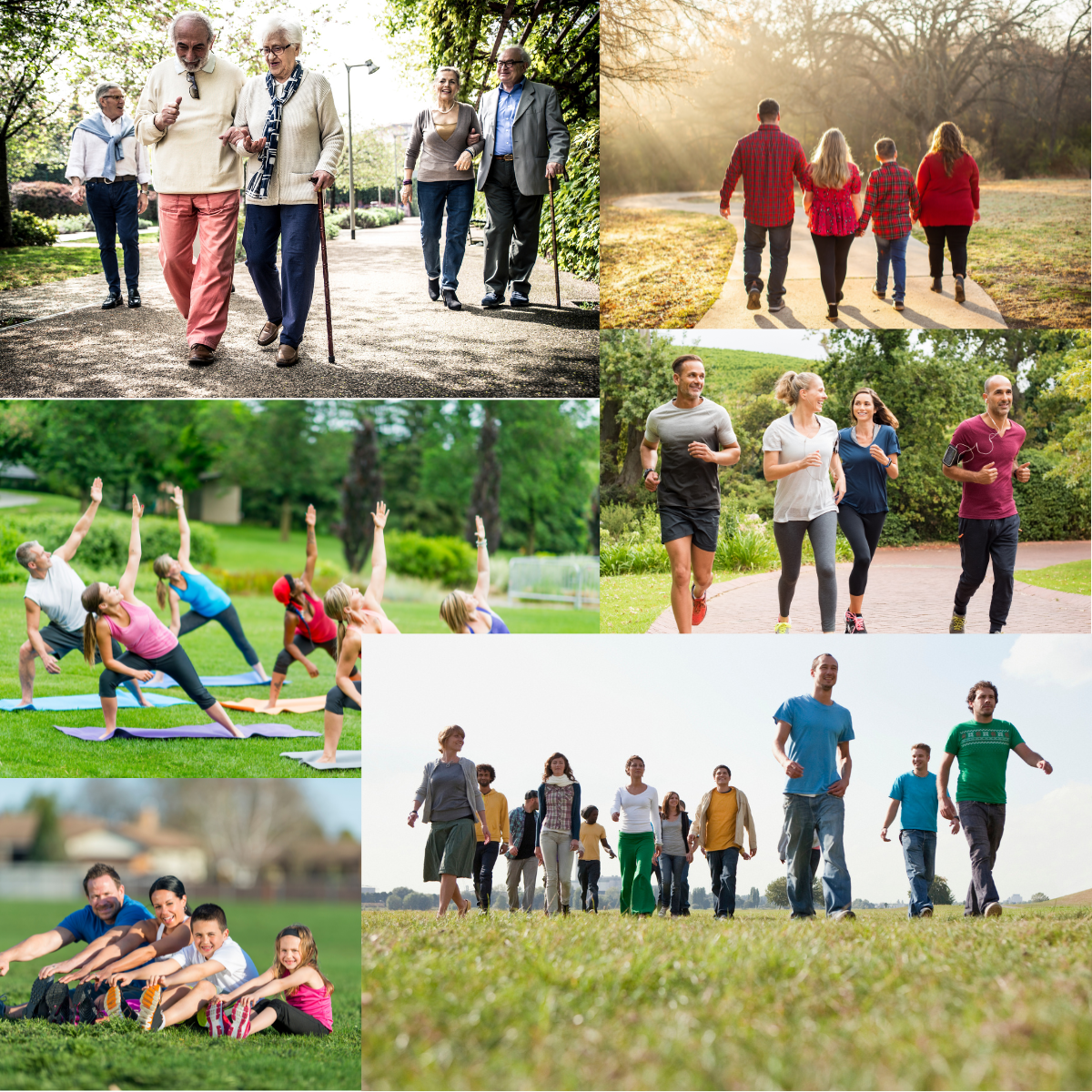
“Walking, running, outdoor exercise, family strolls or group outing – its all good for you!”
I have long believed that the best sort of medicine that any doctor can prescribe is regular exercise. We know from many scientific studies that regular exercise can improve quality of life, especially as we age, and has the potential to reduce many life-threatening illnesses such as high blood pressure, high cholesterol, heart attacks, strokes and even some cancers.
Regular exercise can improve quality of life
I will focus more on the benefits of exercise in future blogs, but a final point – make sure that you exercise safely. If you plan to start after a long period of doing little or nothing or have any doubts about your ability to do even light exercise, ask your GP to check you out before starting. Finally, from a practical perspective, try to let someone know where you are going and what you are doing, and if you are out when the light isn’t good, make sure your wear clothing that allows you to be seen.
Professor John Brewer
Co-Chair, Healthwatch Telford and Wrekin.